
Sovereignty through Architecture: Why Cloud-Exit is a Leap Forward
Moving away from hyperscalers isn't a step backward, it's a strategic decision for financial control, data privacy, and true independence. Here's what decision-makers need to know.
Contents
Sovereignty through Architecture: Why Cloud-Exit is a Leap Forward
Moving away from hyperscalers isn't a step backward, it's a strategic decision for financial control, data privacy, and true independence. Here's what decision-makers need to know.
The Hidden Cost of Convenience
Every month, your finance team approves another cloud invoice. The numbers fluctuate unpredictably, sometimes 15% higher, sometimes 30%. You've accepted this as the cost of doing business in the digital age. Honestly, have you ever stopped to ask what you're actually paying for?
For many organizations, the promise of cloud computing has become a dependency trap. What started as flexibility evolved into vendor lock-in. What was sold as scalability became unpredictable spending. And what was marketed as innovation quietly shifted control of your data to jurisdictions you never chose.
Digital sovereignty isn't a buzzword. It's the difference between owning your infrastructure and renting someone else's rules. The answer to "Who controls your corporate data?" is often uncomfortable. Here's why a strategic cloud-exit isn't a step backward.
Financial Independence: From Variable Costs to Predictability
The OPEX Problem of Public Cloud
The billing model of major cloud providers follows a simple logic: the more you use, the more you pay. That sounds fair, until you look at the reality of business practice.
Typical scenarios that lead to cost explosions:
- Traffic spikes from marketing campaigns double the monthly bill
- Forgotten test environments continue running unnoticed
- Database scaling happens automatically, without prior approval
- Outbound data transfer is billed per gigabyte
One Austrian mid-sized company reported a bill that increased by 340% within a single quarter, without corresponding business growth. The cause: a misconfigured persistent volume claim that went undetected for months.
CAPEX as a Strategic Asset
The alternative is as old as IT itself, but more relevant than ever: investments in your own infrastructure create assets.
| Aspect | Public Cloud (OPEX) | Sovereign Infrastructure (CAPEX) |
|---|---|---|
| Cost Planning | Variable, hard to predict | Fixed, budgetable |
| Tax Benefits | Operating leasing | Depreciation, investment deduction |
| Negotiating Power | Dependent on provider | Independent, own resources |
| Exit Costs | Data export, migration | None, you're the owner |
Concrete example: A company with 50 employees and average IT load pays approximately €2,400 monthly for cloud services. That's €28,800 annually, money that's gone at the end of the year.
The same performance on sovereign infrastructure requires an initial investment of approximately €35,000. After three years, the investment has amortized. From then on, only maintenance costs apply, typically 40-60% less than the original cloud costs.
The Predictability Effect
For CFOs and managing directors, the predictability of IT costs is a strategic advantage. Budget conversations become easier, investment decisions more transparent, and the risk of unpleasant surprises disappears.
Here's why this matters: one manufacturing company in Bavaria reduced their five-year infrastructure costs by 40% after migrating from a major US cloud provider to sovereign hosting. More importantly, they gained the ability to forecast IT spending with 98% accuracy.
Data Privacy and Compliance: Where Your Data Really Lives
The GDPR Reality
The General Data Protection Regulation has been in force since 2018, but the question of data localization remains unclear for many companies. When data is processed in a public cloud, it often ends up in data centers not subject to EU jurisdiction.
The problem with the Cloud Act: The US Cloud Act of 2018 enables US authorities to access data from US providers, regardless of where the data is physically stored. This applies to data of European customers too.
The Consequences for European Companies
Lawyers and data protection officers are increasingly warning about this. A company processing customer data through a US cloud provider could theoretically:
- Have no control over whether authorities access data
- Be unable to fully provide evidence of GDPR compliance
- Be held liable in case of data protection violations
The Solution: Data in Austria and Germany
Sovereign infrastructure or hosting with local providers creates clarity. Data remains in the EU legal space, subject exclusively to European law, and access is physically and logically controllable.
For compliance officers, this means:
- Clear documentation of data processing location
- No third-country transfer risks
- Simplified GDPR audits
- Legal certainty for authorities' inquiries
Built-in compliance: A healthcare provider in Vienna recently passed their GDPR audit in half the expected time. Their auditor noted that the infrastructure documentation was "unusually comprehensive." The reason: sovereignty wasn't retrofitted, it was built in from the start.
| Traditional Cloud | Sovereign Infrastructure |
|---|---|
| Compliance as add-on service | Compliance as default state |
| Data residency requires configuration | Data residency by design |
| Audit trails need enabling | Audit trails always active |
| Privacy as policy | Privacy as architecture |
Vendor Independence: Freedom Through Architecture
Vendor Lock-in: The Invisible Chain
Dependencies develop gradually. A company starts with a simple database in the cloud, adds storage services, integrates authentication services, and suddenly the entire IT architecture is aligned with one provider.
The costs of switching grow exponentially:
- Data migrations are complex and risky
- APIs and integrations must be redeveloped
- Team training is necessary
- Business interruption during migration costs revenue
The result: companies stay with a provider even when performance no longer convinces or prices rise.
The Architecture of Autonomy
Strategic cloud-exit is more than a migration. It's the opportunity to redesign IT architecture with independence as a core principle.
Key principles of a sovereign architecture:
- Open standards instead of proprietary services: What's based on standard technologies is portable
- Documented processes: Every step is traceable and reproducible
- Modular structures: Components can be exchanged without endangering the overall system
- Automation: Repeatable tasks run without manual intervention
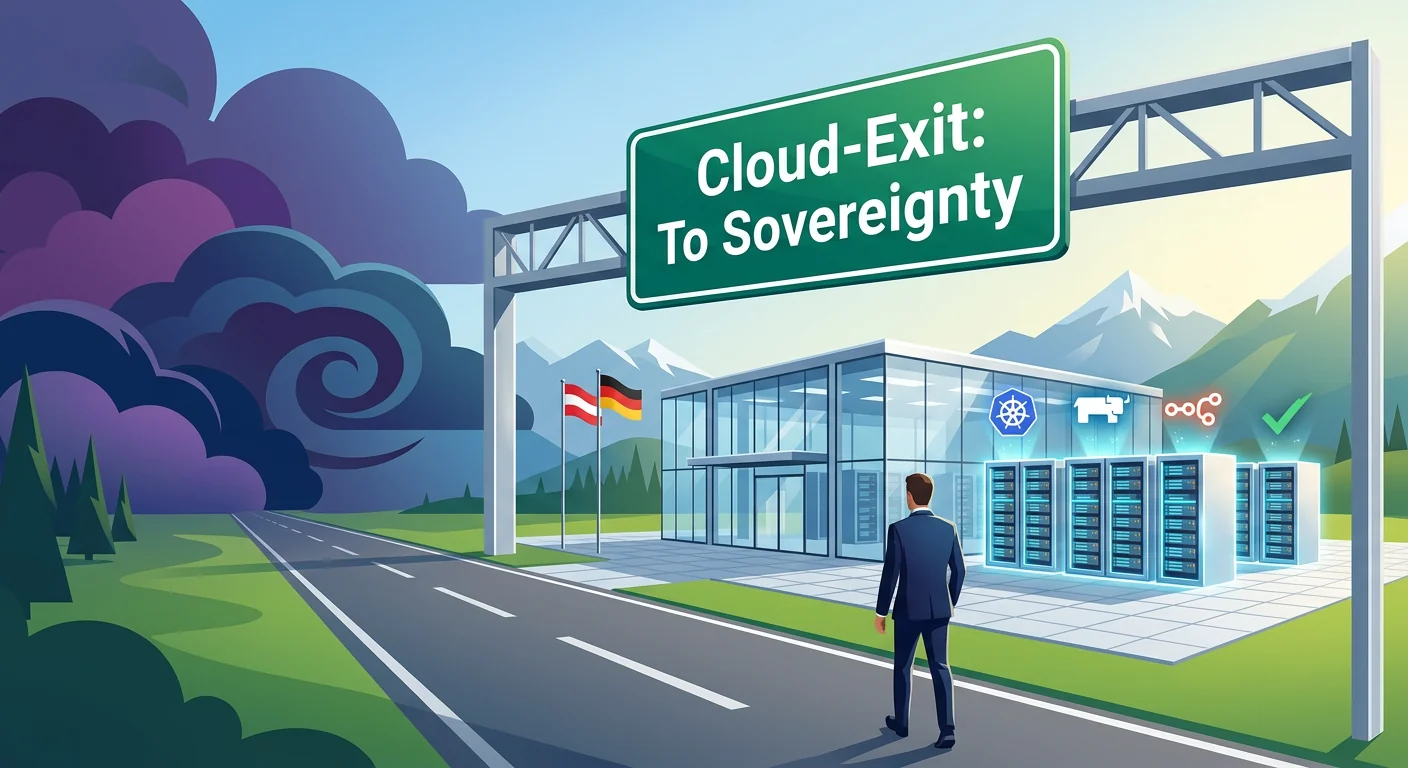
Technical sovereignty through open source: We achieve true independence through Kubernetes (K3s), Rancher orchestration, and Infrastructure as Code (IaC). These aren't just tools, they're industry standards that ensure your infrastructure remains portable, vendor-neutral, and future-proof. No proprietary lock-in, no "back to hardware" image, just modern cloud-native architecture on your terms.
Concrete Business Value
| Independence | Business Benefit |
|---|---|
| Negotiating Power | Better terms with hardware and service providers |
| Agility | Faster response to market changes |
| Risk Minimization | No single points of failure through provider dependency |
| Future-Proofing | Investments in competencies, not dependencies |
One software company in Munich discovered they were paying 3x market rate for database services. They had no leverage because migration would take 18 months. After moving to sovereign infrastructure, their database costs dropped by 60%, and they now have a documented exit strategy for any future vendor negotiation.
Cloud-Exit as Strategic Decision
Digital sovereignty isn't a technical luxury. It's a question of entrepreneurial self-determination. Those who retain control over their data, cost structure, and IT architecture remain capable of acting, today and in the future.
The three pillars of sovereignty:
- Financial predictability through investments instead of variable expenses
- Legal certainty through data localization in the EU legal space
- Freedom of action through independent architecture
The step back from public cloud isn't an admission of technical backwardness. It's a conscious decision for architecture that serves the company, not the other way around.
Examine your current IT landscape for dependencies. Where are incalculable costs arising? Where are your data flows going? Who has control?
The answers could be the beginning of your sovereignty strategy.
Ready to assess your path to sovereign infrastructure? Get in touch for a confidential consultation.